
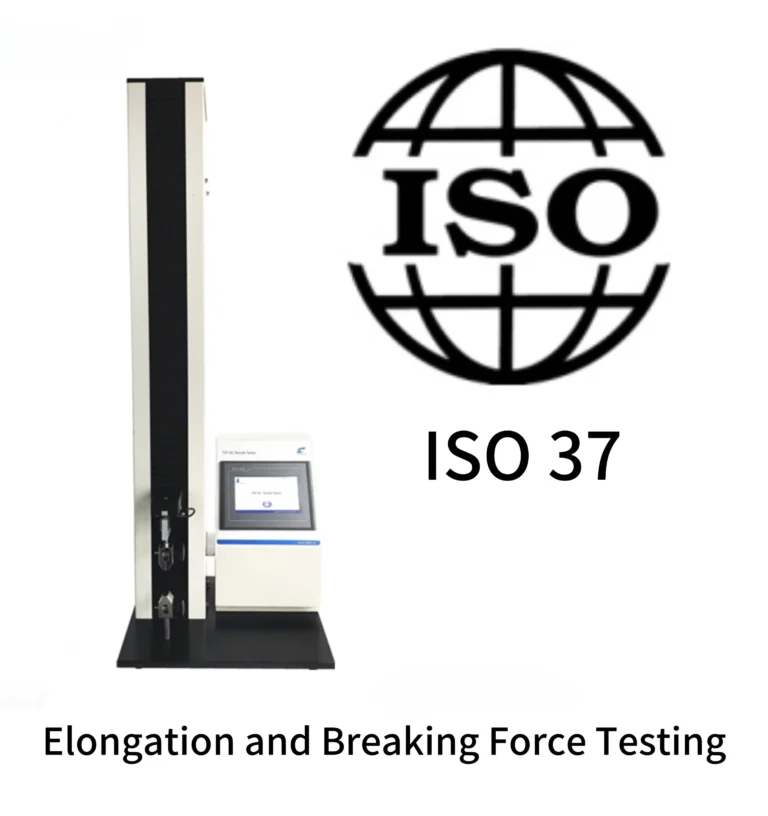
ISO 37
Elongation and Breaking Force Testing
In the field of rubber, thermoplastic elastomers, and flexible thin film materials, mechanical performance is a critical factor in product quality and safety. One key property to evaluate is подовження—how much a material stretches before breaking. The international standard ISO 37 provides a detailed and reliable method for determining the tensile stress-strain properties of vulcanized or thermoplastic rubber. In this article, we explore ISO 37’s testing procedures, its importance in material quality control, and how modern equipment like the TST-01 tensile tester can support accurate and repeatable results.
Elongation and Its Role in Material Performance
In simple terms, подовження is the percentage increase in length a material undergoes when pulled. ISO 37 defines several key measurements, including elongation at break, which reflects how far a sample can stretch before it snaps.
This matters in real-world applications. Seals, gloves, packaging films, medical tubing—these products must be able to stretch without failing. By measuring how rubber or film materials respond under load, manufacturers can predict performance, spot weaknesses, and ensure product reliability.
It’s also important to understand the definition of elongation in a tensile test: it’s the measured strain, expressed as a percentage of the original gauge length, when force is applied. This metric helps link material behavior with real-life application conditions.
Equipment and Setup for ISO 37 Testing
To properly carry out tests according to ISO 37, you need the right equipment:
-
A tensile and elongation testing machine with accurate force and extension measurement
-
Grips designed for dumbbell- or ring-shaped samples
-
A standardized die cutter to prepare consistent specimens
-
Tools for measuring thickness, width, and sample condition
A high-quality mechanical testing machine for thin film elongation—like the TST‑01 Tensile Tester—makes a significant difference in day-to-day lab operations. Its ability to adjust test speeds, support various sample shapes, and provide live feedback on stress-strain curves improves both efficiency and result quality.
Breaking Force and Stress-Strain Behavior
As a tensile test progresses, the breaking force is recorded at the moment the material ruptures. ISO 37 requires tracking several related properties:
-
Міцність на розрив: the maximum stress before failure
-
Подовження при розриві: how far the material stretches before it breaks
-
Stress at a given elongation: how much force is needed to reach a defined extension
-
Elongation at a specific stress: how much the material stretches under a certain load
To record these values with confidence, labs rely on a capable breaking force tester. The TST‑01, for example, offers Class 1 load accuracy and repeatability across a wide range of materials and thicknesses.
ISO 37 Test Procedure for Elongation and Tensile Properties
Not all materials behave the same during testing. That’s why test speed adjustment based on elongation is a key part of ISO 37. The standard specifies speeds like 500 mm/min, but slower or faster settings may be necessary depending on the material’s elasticity or stiffness.
The ability to fine-tune the test speed is essential when dealing with materials that stretch easily—or those that don’t. Using a machine like the TST‑01 allows operators to set speeds that align with both the standard and the specific needs of the material being tested.
1. Sample Preparation
-
Specimen Type: Choose the appropriate shape based on material and test objectives:
-
Dumbbell-shaped specimens (Type 1, 2, 3, etc.) are most common and preferred for міцність на розрив testing.
-
Ring-shaped specimens (Type A or B) may be used for automated setups or where material availability is limited.
-
-
Cutting: Use standard dies or cutters per ISO 37 dimensions. The narrow section of dumbbell specimens should be precisely shaped and smooth to avoid stress concentration.
-
Thickness: Ensure samples fall within standard tolerances:
-
Dumbbells: usually 2.0 ± 0.2 mm
-
Rings: radial width and thickness within ±0.2 mm (Type A)
-
2. Conditioning
-
Before testing, condition the samples at 23 ± 2°C and 50 ± 5% RH for at least 16 hours, following ISO 23529.
-
If the rubber was recently vulcanized, wait at least 3 hours before testing to allow properties to stabilize.
3. Equipment Setup
-
Use a tensile and elongation testing machine (e.g., TST‑01) that meets ISO 5893 Class 1 accuracy.
-
Ensure the grips match the sample shape and prevent slippage.
-
Set the test crosshead speed (typically 500 mm/min, but can be 200 or 100 mm/min depending on sample and elongation behavior).
-
For high-precision strain measurements, use an extensometer compliant with Class D or E (depending on dumbbell type).
4. Testing Procedure
-
Mount the specimen securely in the machine’s grips, aligning it carefully to avoid bending or twisting.
-
Begin the test: stretch the specimen at a constant speed until it breaks.
-
Record force and elongation continuously during the test. For each specimen, obtain the following data:
-
Tensile strength (TS): Maximum stress before failure
-
Elongation at break (Eb): Percentage strain at break
-
Stress at given elongation (Se) і elongation at given stress (Es) if required
-
Choosing the Right Tensile Tester for ISO 37
To fully comply with ISO 37, your розривна машина needs to be more than just accurate—it should also be flexible, user-friendly, and durable.
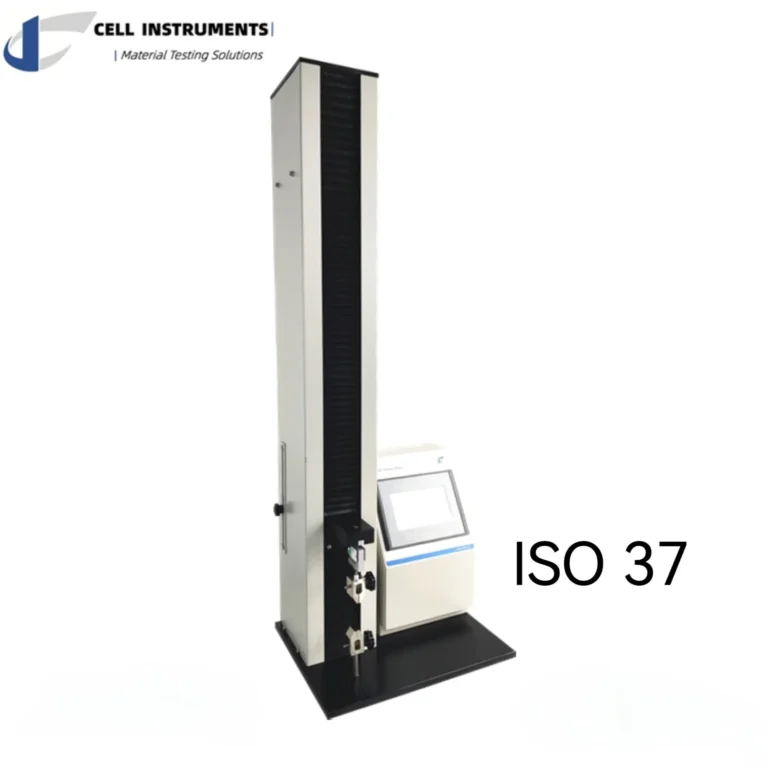
У "The TST‑01 Tensile Tester by Cell Instruments hits all the marks. It’s ideal for:
-
Rubber and elastomer materials
-
Thin films, foils, and flexible packaging
-
Applications in automotive, packaging, medical, and R&D
Key features include:
-
Adjustable testing speeds from 1–500 mm/min
-
Multi-language touch-screen interface
-
Compatibility with dumbbell and ring specimens
-
Live graphing of force vs. elongation
-
Auto-return, limit protection, and optional printout functions
For labs that routinely test elongation at break, or need reliable tensile and elongation testing machines, the TST‑01 offers accuracy and efficiency in one compact, easy-to-operate platform.
Real-World Applications
ISO 37 is used across industries where material flexibility and mechanical strength are essential:
-
Automotive: rubber seals, hoses, grommets
-
Медичні: latex gloves, tubing, film-based packaging
-
Consumer products: athletic goods, footwear, elastic components
-
Packaging: stretch films, barrier layers, flexible laminates
-
Electronics: flexible insulating and protective materials
By measuring elongation and tensile behavior, manufacturers can ensure their products hold up under pressure—literally.
Заключні думки
ISO 37 is more than a testing method—it’s a vital tool for understanding how rubber and flexible materials perform under stress. Whether you’re focused on elongation at break, stress-strain analysis, or choosing the right розривна машина, ISO 37 gives you a reliable framework to work with.
And with advanced instruments like the TST‑01 Tensile Tester від Cell Instruments, your lab can perform ISO 37 tests with confidence—backed by precision, flexibility, and dependable results every time.
 UK
UK  EN
EN  AR
AR  BG
BG  CS
CS  DA
DA  DE
DE  EL
EL  ES
ES  ET
ET  FI
FI  FR
FR  HU
HU  ID
ID  IT
IT  JA
JA  KO
KO  LT
LT  LV
LV  NB
NB  NL
NL  PL
PL  PT
PT  RO
RO  RU
RU  SK
SK  SL
SL  SV
SV  TR
TR