
Plastic film is widely used in packaging, medical devices, agriculture, and industrial applications, where mechanical performance directly affects product safety and functionality. Among the most critical evaluations, the plastic film tensile and elongation test provides essential insight into how a film behaves under stretching forces. This test reveals not only how strong a plastic film is, but also how much it can deform before failure, which is vital for material selection, process optimization, and quality assurance.
This article focuses on standardized testing practices, explains the principles behind tensile and elongation measurements, and guides professionals through reliable testing aligned with industry expectations.
Why ASTM D882 Matters for Plastic Film Testing
ASTM D882 is the most widely adopted standard for determining tensile properties of thin plastic film and sheeting. It establishes uniform test conditions so that tensile strength analysis results remain comparable across laboratories, suppliers, and production sites.
For plastic film manufacturers and quality control teams, ASTM D882 ensures that tensile and elongation test data accurately reflect material behavior rather than variations caused by test setup or operator technique.
Core Concepts of Tensile and Elongation Test
A drag- och töjningsprov applies a controlled stretching force to a plastic film specimen until it breaks. During this process, the testing system records force and extension continuously, generating a stress–strain curve.
From this curve, several key properties are derived:
- Draghållfasthet: the maximum stress the plastic film withstands
- Töjning vid brott: the percentage increase in length before rupture
- Modulus: the stiffness of the plastic film at low strain levels
Together, these parameters form the basis of meaningful tensile strength analysis.
Mechanical Behavior of Plastic Film Under Tension
Plastic film differs from rigid plastics due to its thin structure and viscoelastic behavior. Orientation during extrusion, resin type, additives, and film thickness all influence tensile and elongation results.
Films with high elongation at break often show excellent toughness and flexibility, while films with high tensile strength but low elongation may resist load yet tear suddenly. Understanding this balance allows engineers to tailor plastic film performance for specific applications such as stretch packaging, pouches, or protective layers.
Step-by-Step Tensile and Elongation Test Procedure
- Mount the plastic film specimen securely in the grips of the tensile testing machine.
- Set the initial grip separation and crosshead speed according to ASTM D882 guidance.
- Apply tensile force smoothly until the specimen breaks.
- Record force and extension throughout the test.
- Calculate tensile strength, elongation at break, and modulus based on measured data.
Repeating the test across multiple specimens improves statistical confidence and supports robust tensile strength analysis.
Equipment Considerations for Reliable Testing
Consistent results depend on stable force application, accurate extension measurement, and reliable data acquisition. A dedicated tensile testing system designed for thin materials minimizes slippage and measurement error.
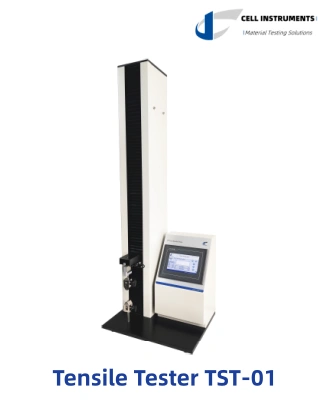
Den Cell Instruments Tensile Tester TST-01 supports plastic film tensile and elongation testing by offering precise speed control, adaptable grips for thin specimens, and stable force measurement. These capabilities align well with ASTM D882 requirements and daily quality control needs without complicating operation.
Practical Value of Tensile Testing in Plastic Film Applications
Plastic film tensile and elongation tests play a vital role in:
- Verifying supplier material consistency
- Optimizing film formulation and orientation
- Supporting regulatory and customer specifications
- Preventing downstream failures during converting or use
When combined with other mechanical and barrier tests, tensile strength analysis provides a comprehensive understanding of plastic film performance.
Slutsats
Den plastic film tensile and elongation test remains a foundational method for evaluating mechanical performance. By following ASTM D882 principles, professionals can generate accurate, comparable data that support material development and quality assurance.
With proper specimen preparation, controlled test conditions, and a reliable testing system such as the Cell Instruments TST-01, tensile and elongation testing becomes a powerful tool for ensuring that plastic film products meet both functional and commercial expectations.
 SV
SV  EN
EN  AR
AR  BG
BG  CS
CS  DA
DA  DE
DE  EL
EL  ES
ES  ET
ET  FI
FI  FR
FR  HU
HU  ID
ID  IT
IT  JA
JA  KO
KO  LT
LT  LV
LV  NB
NB  NL
NL  PL
PL  PT
PT  RO
RO  RU
RU  SK
SK  SL
SL  TR
TR  UK
UK