
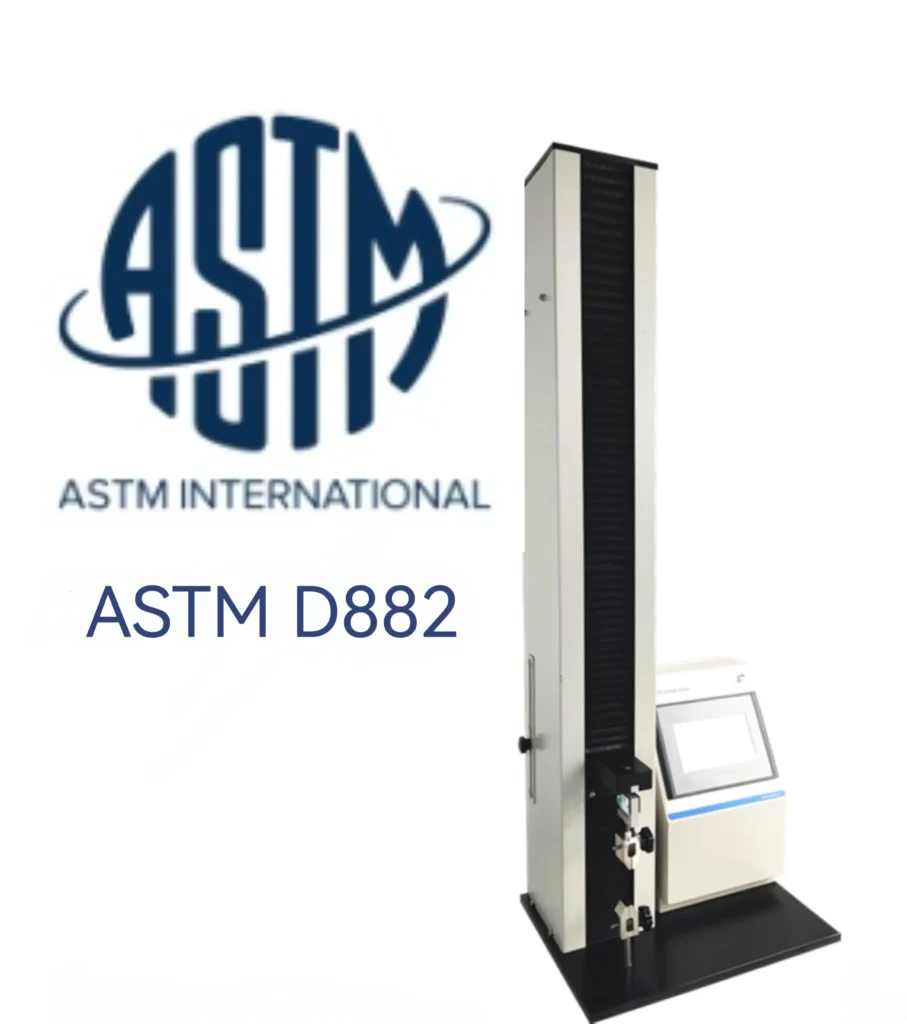
ASTM D882
Plastic Tensile Strength Testing
For manufacturers and quality control professionals in packaging, medical devices, and flexible plastic materials, understanding ASTM D882 is essential. This standard provides a precise framework for conducting plastic tensile strength tests, measuring film tensile strength, and evaluating elongation tensile performance. Accurate tensile and elongation data help ensure durability, reliability, and regulatory compliance—especially for high-performance materials like polyethylene (PE) and laminated films.
This guide explores ASTM D882 in depth, explaining how to measure tensile strength and elongation, select appropriate packaging test equipment, and apply the method using instruments like Cell Instruments’ TST-01 Tensile Tester.
The Importance of ASTM D882
ASTM D882 is the standardized method for testing the tensile properties of thin plastic sheeting and films. It evaluates material behavior under uniaxial tension, determining critical parameters such as:
-
Tensile strength
-
Elongation at break
-
Tensile modulus
-
Tensile energy to break
These properties help assess the mechanical durability of packaging films, barrier materials, and flexible plastics under real-world stress during sealing, transportation, or consumer use. When dealing with tensile and elongation test data, even minor inconsistencies in specimen preparation or grip separation can significantly affect results.
Tensile Strength Measurement Explained
ASTM D882 specifies using a constant-rate-of-crosshead movement tensile tester, which gradually pulls the film specimen until it fails.
Key testing conditions include:
-
Specimen width between 5 mm to 25.4 mm,
-
Grip separation length of 100 mm to 250 mm depending on the modulus requirement,
-
Test speed calculated based on the desired strain rate.
The specimen is carefully clamped to minimize slippage. The tensile strength measurement is calculated as the maximum force divided by the cross-sectional area of the specimen.
When testing polyethylene tensile strength, it’s important to test in both the machine and transverse directions if the material shows anisotropy.
Understanding Tensile and Elongation
Tensile and elongation properties directly relate to a film’s resistance to breakage during use. The elongation tensile test measures how much a material stretches before breaking, providing insight into flexibility and ductility.
-
High tensile strength indicates resistance to mechanical stress.
-
High elongation indicates flexibility and stretchability.
For heat seal strength applications, materials must combine tensile durability with compliant elongation. Excessively brittle or weak films may tear under minimal load, leading to package failure.
Recommended Equipment
ASTM D882 requires highly precise and programmable tensile testers. Cell Instruments’ TST-01 Tensile Tester is ideal for performing plastic tensile strength tests under ASTM D882 conditions. Key capabilities include:
-
Adjustable speed from 1 to 500 mm/min to meet various material requirements.
-
High accuracy force range from 0 to 1 kN with ±0.5% FS precision.
-
Real-time data visualization and programmable test parameters.
-
Multi-fixture compatibility for tensile, elongation, peel, and puncture tests.
-
7-inch HMI touchscreen for intuitive control and easy parameter adjustments.
With built-in programs for tensile strength measurement, elongation, peel tests, and more, the TST-01 ensures consistent results across a wide range of packaging test equipment needs.
Testing Procedure
Here’s how a typical test process works:
-
Prepare specimens according to the width, thickness, and gage length specified.
-
Calibrate the machine and set the required grip separation and strain rate.
-
Mount specimens in the tensile tester carefully to avoid slippage.
-
Start the test, recording force and extension data throughout.
-
Analyze results for tensile strength, elongation at break, modulus, and energy to break.
For high-precision applications, an extensometer or force-extension plotting capability improves analysis accuracy. The TST-01 supports both, ensuring reproducible and traceable data.
Applications Across Industries
Whether you’re testing film tensile strength in pharmaceutical blister packs, tensile and elongation test performance of laminated food pouches, or tensile strength of polyethylene medical drapes, ASTM D882 applies widely:
-
Medical device packaging
-
Flexible film food pouches
-
Industrial laminate layers
-
Sterile barrier systems
-
Pharmaceutical sachets
Proper implementation of ASTM D882 using the right tensile tester safeguards product reliability, regulatory compliance, and end-user satisfaction.
Conclusion
Mastering ASTM D882 helps professionals across packaging, medical, and material science industries evaluate material integrity with confidence. By understanding tensile strength, elongation, and how to conduct precise tensile testing, you can make informed decisions about material selection and package design.
For labs seeking precision and efficiency in tensile testing, Cell Instruments’ TST-01 Tensile Tester offers unmatched versatility and accuracy. It’s an ideal choice for all plastic tensile strength test applications and more.
 EN
EN  AR
AR  BG
BG  CS
CS  DA
DA  DE
DE  EL
EL  ES
ES  ET
ET  FI
FI  FR
FR  HU
HU  ID
ID  IT
IT  JA
JA  KO
KO  LT
LT  LV
LV  NB
NB  NL
NL  PL
PL  PT
PT  RO
RO  RU
RU  SK
SK  SL
SL  SV
SV  TR
TR  UK
UK